
Full Confidence
I’ve been playing No. 10: Full Confidence, a political game in which you are prime minister and your main task is to survive. There is virtually no economics, little sense of administrative capacity and almost no attempt to model whether your policies actually work. Instead, you have to keep four groups reasonably happy: the public, the media, the cabinet and your backbenchers. That sounds simplistic, but it may also be the game’s most revealing feature. The developer has said that people working in politics and the civil service have told him it is “close to the bone”, which is perhaps not especially reassuring.
 The first few times I played, I concentrated on the public. That seemed obvious. In a democracy, surely the electorate is the constituency that matters most. It turns out that this is a good way of getting removed from office. The public quite often loved me, but the cabinet or the backbenchers did not, and eventually one of them brought me down. Once you have failed like that a few times, you begin to understand what the game is really teaching you: instead of asking “what is the best response?”, you start asking “which group can I afford to annoy?”
Housing is a perfect example. One scenario tells you that home ownership among under-40s has collapsed and offers a major housebuilding programme as one possible response. What the game does not ask is how much it will cost, where the land will come from, whether councils can cope or whether the construction industry has the capacity. The crucial question is how the backbenchers will react. A large housebuilding programme may be popular nationally while being intensely unpopular with MPs whose constituents will actually have the houses built next door. The future residents of a new town do not yet live there. The people whose view is about to disappear behind 2,000 new homes most certainly do.
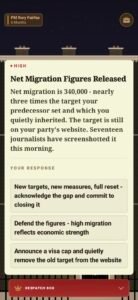
The same applies to immigration. In another scenario, net migration is far above an old government target and journalists have found the promise still sitting on the website. Again, the game barely asks what level of migration Britain actually needs or what the economic consequences are. The problem is that reality no longer matches something the government once promised. As one reviewer put it, the game captures the “relentless, bludgeoning conveyor belt of issues” arriving at the prime minister’s desk. The satire works because reality reaches Downing Street already converted into a political-management problem.
That is also where the game becomes rather bleak. Its hidden model is effectively that policy is cheap and politics is expensive. You can announce new towns, visa caps or spending programmes without having to find the money, workers or administrative capacity. The scarce resource is political capital. Real life is the opposite. Announcing 200,000 houses is easy. Building them is hard.
And this, I think, is why Westminster politics is broken. The British system gives the prime minister enormous nominal power, while making their survival depend on constantly managing cabinet ministers, backbench factions, newspapers and voters. That creates especially bad incentives for problems where the real solution is costly now, creates identifiable losers and only pays off years later. Housing, infrastructure, energy, social care and productivity all fit the pattern. A prime minister may know perfectly well what needs to be done, yet if doing it causes an immediate revolt among thirty MPs while the benefits will not become visible until 2035, the rational response may be to delay it, dilute it or replace it with something more politically convenient.
The disturbing thing is that this does not require British politicians to be unusually stupid or cowardly. They may simply be behaving rationally within a bad system. No. 10’s central lesson is that governing Britain and remaining prime minister are not the same task. The first requires solving problems in the outside world; the second requires maintaining political equilibrium inside Westminster. Too often, the system rewards the second at the expense of the first.
And if a political system repeatedly teaches its leaders that solving a real problem is optional but keeping the backbenchers happy is existential, it should hardly surprise us that Britain has accumulated so many unresolved problems.