
Penrose and Schrödinger
 As Scotland votes today, we are not only waiting to find out how many MSPs each party will win. We are waiting, once again, to see how the result will be interpreted, because Holyrood elections are now never merely ordinary parliamentary elections. Every result is immediately dragged into a much older argument: is Scotland a nation in a voluntary union, or a region of a larger British state?
The UK has never answered that question properly. For a long time, that was not a weakness but a feature, because British constitutionalism has often depended on refusing to define things too precisely. Scotland could be a proud nation in one speech and a component part of a unitary state in another. Westminster could be sovereign in law, while the Scottish people were sovereign in political rhetoric. Everybody could say the bit that suited the room they were in. It was government by constructive ambiguity, like most British institutions, only more so.
I have written about this twice before. In 2012, in a post called Scotland should have 109 MPs, not 52, I argued that representation at Westminster only makes sense if we first decide what sort of state the UK is. If the UK is simply one country divided into electoral districts, then equalising constituencies by population is logical enough. Scotland, Wales and Northern Ireland should then be treated like English regions, with no special weighting and no particular constitutional status. But if the UK is a union of nations, that logic breaks down.
In that post I discussed the Penrose method, or square-root formula, which allocates representation according to the square root of population. At first sight, that sounds like special pleading for smaller nations, but it is really an attempt to solve a structural problem in a multi-level political system. The problem is easiest to see without the formula, because nothing ruins a political argument faster than making the reader feel they have accidentally opened a statistics textbook.
Imagine Westminster is discussing a law that formally concerns a reserved matter, but in practice has enormous consequences for devolved areas such as health or education. Perhaps the measure is fine for England, or at least manageable there, but disastrous for Scotland, Wales and Northern Ireland. It might squeeze budgets, distort administrative systems or impose indirect consequences that the devolved governments then have to absorb. Under the present system, England’s size dominates the Commons. The three smaller nations might all oppose the measure, and all three might have good reasons to do so, defending their own institutions, budgets and public services. Yet they would have little chance of blocking it, and might not even receive much debating time. In population terms, that looks fair. In union terms, it looks much less so: three of the four nations can be overruled almost casually by the fourth.
Penrose is one way of addressing that problem. It does not treat the UK as a single flat electorate, but as a union made up of political communities of very different sizes, and it tries to prevent the largest one from turning population into permanent constitutional dominance. On that basis, Scotland would not have had roughly 52 MPs in a 600-seat House of Commons. It would have had something like 109. That figure was never likely to appear in a Westminster reform bill, since Whitehall is not known for suddenly deciding that Scottish constitutional theory deserves a generous numerical cuddle. But as a thought experiment, it was useful. It asked whether the UK was willing to take its own rhetoric seriously. If Scotland, Wales, Northern Ireland and England are nations joined together in a union, why does the central parliament look so much like the parliament of England with some Celtic attachments?
Other countries solve this problem differently. The United States has a population-based House of Representatives and a Senate where every state has two senators. Germany has the Bundestag and the Bundesrat, with the Länder represented separately. The details differ, but the principle is familiar: if the state is federal or multinational, raw population cannot be the only constitutional fact. The UK, naturally, has found a worse arrangement. It has a House of Commons that behaves like the democratic chamber of a unitary state, a House of Lords that is neither a proper territorial chamber nor meaningfully democratic, and devolved parliaments whose authority depends on Westminster’s continuing consent. It is a constitutional lasagne made of conventions, evasions and historical leftovers.
After 2014, the UK had a chance to turn ambiguity into structure. It could have created a more openly federal system, reformed the Lords into a chamber of the four nations modelled loosely on the US Senate, balancing a population-based Commons with a second chamber where Scotland, Wales, Northern Ireland and England were represented as nations. It could also have defined a democratic route by which Scotland, or any other constituent nation, could revisit the question of membership. Instead, it did none of these things, which was constitutionally revealing even if nobody in Westminster seemed inclined to look directly at what had been revealed.
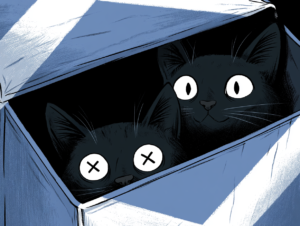
Then, in 2020, I wrote another post, Schrödinger’s country and Schrödinger’s mandate. There I argued that Scotland had long existed in an indeterminate state: both a sovereign nation and a region of the UK, depending on context. The 2014 independence referendum opened the box, and the ambiguity collapsed. For Unionists, the result meant that Scotland had chosen to be part of the UK as a region of a single state. For independence supporters, it meant that Scotland had acted as a nation and chosen, for the time being, not to become independent. Those are not minor differences of emphasis. They are different constitutional realities, and that is why so much political argument since 2014 has felt strangely circular. People are not merely disagreeing about independence. They are disagreeing about what Scotland already is.
The years since have made the problem worse, not better. Theresa May’s “now is not the time” after the Brexit vote was a turning point, because before 2014 such a phrase would have sounded almost impossible. The UK Government would have been expected to maintain the polite fiction that Scotland’s status was special and that Scottish democratic wishes had to be accommodated. After 2014, Westminster increasingly behaved as though the first referendum had settled the deeper question: Scotland was now, constitutionally, just a region.
The Supreme Court’s 2022 judgment confirmed the legal position. The Scottish Parliament does not have the power to legislate for an independence referendum without Westminster’s consent, because the Union and the sovereignty of the UK Parliament are reserved matters. Legally, the ambiguity is gone. Westminster holds the key.
So the two old posts were really making the same argument from different directions. The Penrose post asked: if Scotland is a nation within a union, why does the UK not give Scotland the institutional weight that such a union would require? The Schrödinger post asked: if Scotland is a nation within a voluntary union, why can Westminster decide unilaterally whether Scotland is allowed to test that union democratically? The uncomfortable answer is that the UK wants the language of union without the machinery of union. It wants Scotland to feel like a nation when that helps bind it emotionally to Britain, but to function like a region when Scotland’s national will becomes inconvenient.
This is why today’s Holyrood election matters beyond the usual parliamentary arithmetic. The Scottish Parliament has 129 MSPs, and every voter in Scotland is represented by eight of them: one constituency MSP and seven regional MSPs. It is a proportional parliament designed, at least in broad terms, to reflect Scotland’s political choices. If current polling is right, Scotland may once again return a parliament with a pro-independence majority. YouGov’s final MRP projects the SNP on 62 seats, just short of an outright majority, with the Greens on 16; it also says that in 99% of its simulations the SNP and Greens together have more than enough seats to govern. YouGov describes the likely result as the most pro-independence Scottish Parliament to date.
And once again, Westminster may simply ignore it. That is now the real constitutional question. Not whether Westminster can ignore such a mandate. Legally, it can, and the Supreme Court has made that clear. The question is how long a state can continue calling itself a voluntary union while one of its nations repeatedly elects parliaments asking for the right to reconsider the union, and the central government repeatedly answers: no.
Perhaps this can last for a long time. Constitutions can survive on denial for decades, and the UK constitution has survived on less nourishing substances than that. But something important has changed. Before 2014, the UK could avoid deciding whether Scotland was a nation in a union or a region in a unitary state. After 2014, after Brexit, after “now is not the time” and after the Supreme Court judgment, that ambiguity has gone. Westminster may still speak the language of union, but its actions increasingly describe a unitary state.
So while we wait for the results, the question underneath this election is not simply whether Scotland will again produce a pro-independence majority. It is whether such a majority now has any recognised constitutional meaning at all. If the answer from Westminster is once again no, then the status quo may continue, but it will continue as something much starker than before: not a voluntary union waiting for Scottish consent, but a British state waiting for Scottish resistance to exhaust itself.