
Medieval advice on Greenland
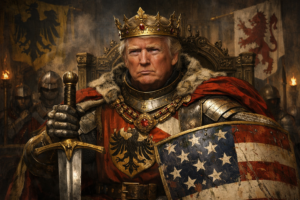 One of the quiet illusions of modern politics is that we have outgrown older forms of power. We tell ourselves that treaties have replaced tribute, that dialogue has replaced dominance, that explanations have replaced coercion. Most of the time, this is just about true enough to keep the system running. And then someone comes along who behaves as if none of that were quite settled, and the illusion cracks.
A medieval observer would not be surprised by the current Greenland drama. He would find the European response baffling in a very specific way: not because it is immoral or foolish, but because it assumes that words bind those who are testing how far they can push.
When a powerful actor demands something that is not his, the medieval instinct is not to argue about justice. Justice is a fine thing, but it does not restrain ambition. The first question is simpler and colder: what will it cost him to continue? If the answer is “very little”, then the demand will not disappear, no matter how many reasonable explanations are offered in response.
This is where modern diplomacy keeps tripping over its own decency. Faced with a claim framed in respectable language – security, stability, alliance obligations – European leaders instinctively engage with the language itself. They reassure, clarify, align, explain. They point out that the stated concern has already been addressed. They behave as if the problem were a misunderstanding.
A medieval adviser would shake his head. He would note that explanations do not bind those for whom the explanation is not the cause. If the motive lies elsewhere – in dominance, optics, leverage, or simple appetite – then rebutting the stated reason is beside the point. One is fencing with shadows while the real contest happens off-stage.
Timing, too, would loom larger in a medieval reading than it does in a modern one. Actions taken “coincidentally” while talks are ongoing are not neutral. They are read as messages, whether intended or not. Troops arriving as envoys speak may feel like reassurance to those who believe in shared frameworks. To someone primed to read power, they look like movement under cover of politeness. In that mental world, retaliation becomes not escalation but response.
None of this requires paranoia. It requires accepting that not all actors inhabit the same interpretive universe. Where one side sees coordination, the other sees challenge. Where one side sees good faith, the other sees weakness or deception. The tragedy is not that these readings exist, but that they are so rarely anticipated.
Unity matters here in a way that modern institutions often forget. Medieval leagues learned quickly that partial responses were worse than none at all. A single voice, even a quiet one, constrained ambition more effectively than a chorus singing in different keys. Today’s “close consultations” and “ongoing dialogue” signal process, not resolve. To an impatient challenger, process looks like space.
Most uncomfortable of all is the medieval view of cost. Deterrence that lives entirely in the future is a fragile thing. Promises of retaliation later teach patience, not restraint. What mattered, then as now, was immediate inconvenience clearly linked to the behaviour one wished to discourage. Not outrage. Not moral suasion. Simply consequence.
And above all, medieval politics understood something modern Europe finds almost impossible to say aloud: never reward pressure. Yield once under threat, and the threat becomes the method. Even if compromise is inevitable, it must never appear as the fruit of coercion. Delay it, disguise it, reroute it if necessary – but do not let it be seen as a response to force.
This is not a call to abandon norms, law, or dialogue. Medieval advisers were not nihilists. They were realists shaped by environments where trust had to be engineered, not assumed. They believed in promises, but only when breaking them was costly. They valued peace, but only when refusal was credible.
The lesson they would offer today is not to become more aggressive, but to become more legible. Power tests clarity. It retreats from predictable resistance and advances into polite ambiguity. If norms are to survive encounters with those who treat them as optional, they must be anchored in behaviour, not just belief.
The mistake Europe keeps making is not moral. It is anthropological. It assumes that everyone means what they say, and that saying the right things will shape what happens next. Medieval politics was built on the opposite assumption: that words are cheap, intentions opaque, and only structured consequence turns speech into commitment.
Greenland, in that light, is not just about territory or tariffs. It is a reminder that history never really leaves the room. It just waits patiently for us to forget why its lessons were learned in the first place.